Disclosure: Top Local Diner is reader-supported. When you buy through links on our site, we may earn an affiliate commission. Learn more.
Ask anyone seated around a crowded November table what they are actually looking forward to eating, and nine times out of ten the honest answer is not the turkey. It is the supporting cast of starches that anchor the plate. Stuffing, mashed potatoes, and pan gravy do the heavy lifting of Thanksgiving dinner, yet they are frequently treated as afterthoughts squeezed into the final thirty minutes before service. In professional diner kitchens and traditional family restaurants, these three dishes are treated with strict technical discipline. When mashed potatoes turn gluey, when stuffing comes out soggy in the middle, or when gravy separates into a greasy pool on the plate, the culprit is almost always a small misstep in temperature or ingredient order. Mastering the physics of how bread absorbs custard, how potato starch granules react to fat, and how flour binds pan drippings will change the way you cook every holiday meal.
1. The Architecture of Great Stuffing (and Why Dressing Wins)
The distinction between stuffing and dressing starts as a matter of geography and ends as a matter of food safety. In the American South and large parts of the Midwest, the dish baked in a shallow casserole pan is properly called dressing, while Northern tables call it stuffing regardless of whether it ever saw the inside of a bird. From a strictly culinary standpoint, baking your bread mixture in a dedicated cast iron skillet or ceramic baking dish is superior in every measurable way.
To cook stuffing safely inside a turkey cavity, the center of the bread mass must reach 165°F to neutralize poultry bacteria that seep from the raw bird. By the time heat penetrates all the way to the center of a tightly packed cavity, the surrounding white breast meat has usually climbed past 180°F and lost all of its moisture. Worse, cavity stuffing steams in the dark, preventing it from developing the shattered, golden brown top crust that provides texture against soft potatoes and tender meat.
Staling vs. Drying: The Bread Science
Walk into any test kitchen in November and you will hear the same advice: leave your cubed bread out on baking sheets overnight to go stale. While well intentioned, staling and drying are two completely different chemical processes. Staling is retrogradation, where starch molecules recrystallize and firm up while trapping moisture inside the crumb. Drying is simple evaporation. If you use stale bread that still holds internal moisture, it cannot drink up the savory broth and egg custard you pour over it. Instead, the liquid sits between the cubes and steams them into a dense paste.
Always oven dry your bread cubes at 275°F for 40 to 45 minutes until they feel like crisp croutons all the way through. Choose a sturdy loaf with open structure, such as a high hydration country sourdough, a braided challah, or a classic French batard. Avoid soft commercial sandwich loaves made with dough conditioners, which dissolve on contact with warm stock.
The Custard Formula
The best pan stuffing is structurally a savory bread pudding. If you moisten dried bread with stock alone, the cubes swell during baking and then collapse as they cool, leaving a wet, heavy slab. Whisking two whole eggs into every three cups of rich poultry stock creates a delicate protein network that sets at 160°F, lifting the bread cubes into a light, soufflé like interior beneath a crisp, buttery crust. Sweat your diced yellow onions, celery ribs, and garlic slowly in a generous full stick of butter with bruised sage leaves, fresh thyme, and rosemary so the fat carries those fat soluble herb aromas into every single crumb.
2. Regional American Stuffing Traditions
Across the United States, local agricultural history and immigrant kitchens have shaped distinct regional versions of the holiday pan dressing. If you are building a menu with local character or ordering from a regional restaurant, these are the four foundational styles worth knowing.
| Regional Style | Primary Base | Signature Aromatics & Mix Ins | Texture Profile |
|---|---|---|---|
| New England Tavern | Crusty white country bread | Salt pork or bacon, sage, thyme, roasted chestnuts, cider | Crisp top crust with distinct, chewy bread cubes |
| Southern Skillet Cornbread | Unsweetened white cornmeal cornbread & day old biscuits | Abundant celery, onions, rubbed sage, hard boiled eggs, black pepper | Moist, cake like crumb with caramelized skillet edges |
| Mid Atlantic Coastal Oyster | Toasted brioche or pullman loaf | Poached shucked oysters, oyster liquor, celery leaves, lemon zest, mace | Silky, briny custard interior with delicate crust |
| Midwestern Sausage & Apple | Hearty sourdough & rye cubes | Bulk pork sage sausage, tart Granny Smith apples, pecans, parsley | Rich, savory sweet balance with hearty bite |
3. The Physics of Velvety Mashed Potatoes
Every diner cook who has prepped fifty pounds of potatoes for the Sunday rush knows that the difference between cloud like mashed potatoes and wallpaper paste comes down to how you handle swollen starch cells. Inside a raw potato, starch is locked in microscopic granules. As the potato simmers in water between 135°F and 150°F, those granules absorb water and swell like tiny balloons. If you rupture too many of those swollen cells through violent mechanical action, such as blitzing them in a food processor or running a hand mixer at high speed, free amylose starch spills out and links together into a sticky, elastic web.
Choosing the Right Potato Variety
- Russet (Idaho) Potatoes: High starch and low moisture. When baked or simmered gently and passed through a ricer, Russets fall apart into dry, fluffy flakes that can absorb huge quantities of butter and cream without becoming heavy.
- Yukon Gold Potatoes: Medium starch with a dense, buttery cell structure and natural carotene pigment. They produce a denser, creamier, deeply savory purée.
- The Diner Kitchen 50/50 Blend: Combining equal weights of Russet and Yukon Gold potatoes gives you the best of both worlds: the lofty, absorbent fluffiness of Russets paired with the rich golden body and buttery flavor of Yukons.
Three Rules That Guarantee Zero Gumminess
- Start in Cold Water and Simmer Gently: Cut peeled potatoes into uniform 1.5 inch chunks and cover them with cold, generously salted water before turning on the burner. Starting in boiling water overcooks the exterior before heat reaches the center, causing the outside to slough off and waterlog the pot. Keep the water at a gentle bubble around 195°F to 200°F rather than a violent rolling boil so the chunks do not smash against one another.
- Steam Dry in the Hot Pot: Once fork tender, drain the potatoes and return them immediately to the warm, dry pot over low heat for two full minutes, shaking the pan gently. Watching the white steam rise off the potatoes means surface water is evaporating, making room inside the starch cells for butter and cream.
- Always Add Fat Before Liquid: This is the single most important rule in potato cookery. After ricing or mashing the hot potatoes, fold in your softened butter first until every flake is coated in fat. Fat coats the starch granules in a waterproof lipid barrier. When you pour in warm whole milk or heavy cream afterward, the liquid emulsifies smoothly into the butter rather than bonding directly with raw starch to form glue.
4. Pan Gravy That Never Breaks or Lumps
Gravy is the culinary glue that unifies the Thanksgiving plate, yet last minute panic at the stove while the turkey rests leads to two common disasters: pale gravy floating with raw flour lumps, or a broken sauce with a slick of yellow fat swimming on top.
Both problems are solved by understanding how a roux works. A roux is an equal weight mixture of fat (ideally the rendered butter and turkey fat skimmed from your roasting pan) and all purpose flour. For every one cup of liquid stock, use 1.5 tablespoons of fat and 1.5 tablespoons of flour for a classic coating consistency, or 2 tablespoons of each if you prefer a thicker diner style gravy.
How to Build Deep Flavor and Prevent Lumps
Never whisk cold flour directly into hot pan drippings and liquid. Instead, pour all the contents of your roasting pan into a fat separator or tall glass measuring cup. Let it settle for three minutes until the clear golden fat rises to the top and the dark amber pan juices sit underneath. Spoon the measured fat back into the roasting pan or a wide stainless steel skillet over medium heat. Whisk in your flour and cook that paste for four to five minutes until it smells like toasted pie crust and turns the color of peanut butter. Cooking the roux removes the chalky taste of raw wheat and coats each starch granule in fat so it cannot clump when liquid hits the pan.
Warm your turkey stock in a separate saucepan first. Whisking warm stock into a hot roux in three steady additions produces an instant velvet emulsion. Once simmering, scrape up every browned bit of fond from the roasting pan, simmer for five minutes to let the starch fully gelatinize, and finish with a splash of apple cider vinegar, dry sherry, or Worcestershire sauce. That tiny hit of acid cuts through the richness of the fat and wakes up the savory poultry notes.
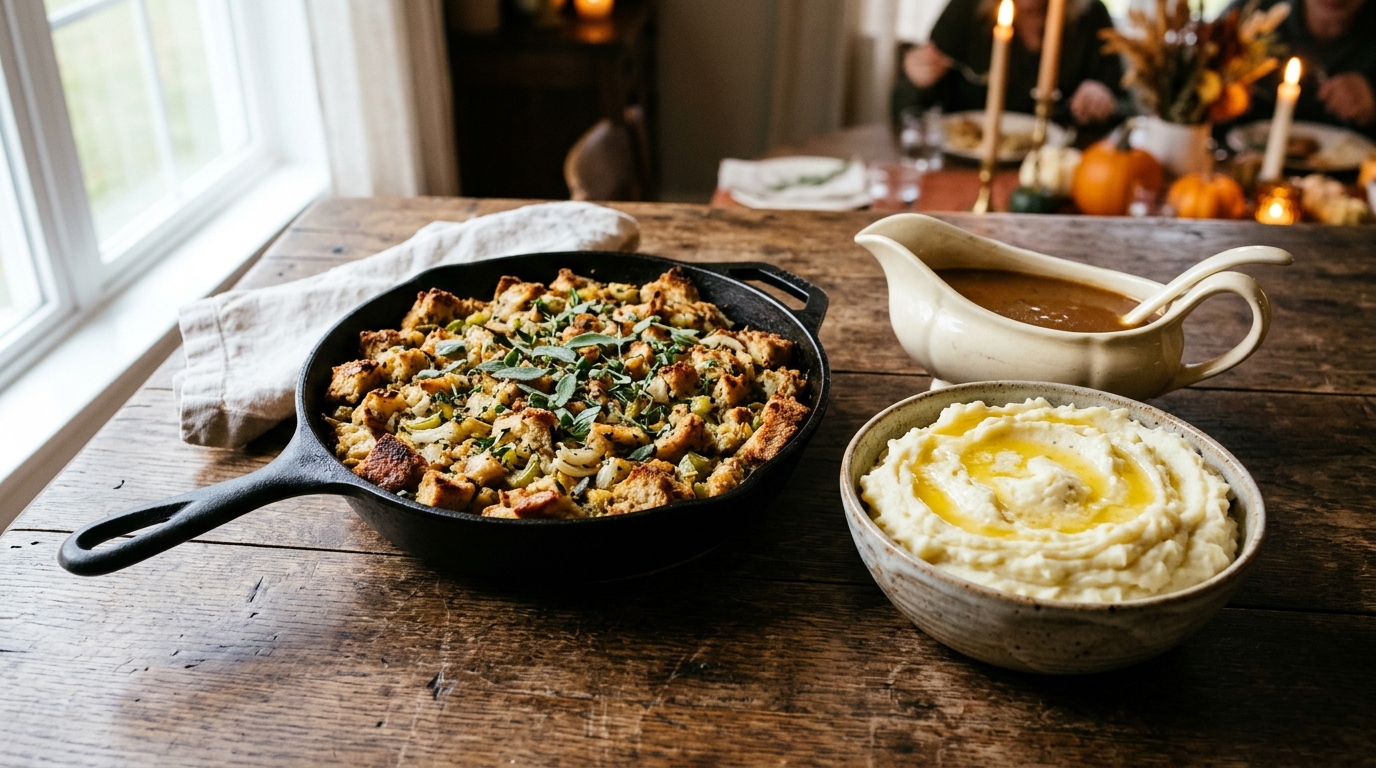
Master Recipe: Classic Diner Style Herb Pan Stuffing & Velvety Gravy
This foundational recipe yields a ten serving cast iron skillet of golden herb stuffing alongside four cups of rich, glossy pan gravy.
Ingredients
- 1.5 lbs crusty country sourdough or challah bread, cut into 3/4 inch cubes (about 12 cups)
- 1 cup (2 sticks) unsalted butter, divided
- 2 large yellow onions, finely diced (about 3 cups)
- 5 ribs celery with leafy tops, finely diced (about 2 cups)
- 4 cloves garlic, minced
- 3 tablespoons fresh sage leaves, finely chopped
- 1.5 tablespoons fresh thyme leaves, stripped from stems
- 1/2 cup fresh flat leaf parsley, finely chopped
- 3 cups homemade or low sodium turkey stock (plus 4 cups more for gravy)
- 2 large eggs, room temperature
- 6 tablespoons all purpose flour (for the pan gravy)
- 1.5 teaspoons Diamond Crystal kosher salt and 1 teaspoon freshly cracked black pepper
Instructions
Dry the Bread Cubes: Spread the cubed bread across two rimmed baking sheets. Bake at 275°F for 40 to 45 minutes, tossing halfway through, until completely dry and crisp like croutons without browning. Cool completely and transfer to a large mixing bowl.
Sweat the Aromatics: Melt 1.5 sticks (12 tablespoons) of butter in a large 12 inch cast iron skillet over medium heat. Add the diced onions, celery, garlic, sage, thyme, salt, and pepper. Cook gently for 12 to 15 minutes until softened and translucent without browning. Stir in the parsley and pour the entire mixture over the dried bread cubes.
Bind with Savory Custard: Whisk the 2 eggs with 2 cups of the turkey stock until smooth. Pour over the bread and fold gently. Add the remaining 1 cup of stock gradually until the cubes are evenly moistened with no standing liquid at the bottom of the bowl.
Bake Dual Stage: Pile the stuffing loosely back into the buttered cast iron skillet or a 9x13 inch baking dish, leaving peaks on top. Dot with the remaining 4 tablespoons of butter. Cover with foil and bake at 375°F for 25 minutes to set the custard, then uncover and bake for 20 to 25 minutes more until the top peaks are deep golden brown and crisp.
Build the Pan Gravy: Skim 6 tablespoons of fat from your turkey roasting pan (or melt 6 tablespoons butter) in a wide saucepan over medium heat. Whisk in 6 tablespoons of flour and cook, stirring constantly, for 4 minutes until toasted and nutty. Slowly whisk in 4 cups of warm turkey stock and pan drippings. Simmer for 5 minutes until glossy and thick enough to coat the back of a spoon.
Explore More
The Takeaway
Great Thanksgiving sides rely on controlling starch and water: stale your bread in the oven rather than on the counter, add butter to mashed potatoes before a drop of milk touches the pot, and build gravy on a toasted flour roux cooked for at least four minutes.
About the Author
Sarah is a culinary historian who spends her time tracing the origins of classic American comfort food and diner culture.